Find Stable Work in Manufacturing: Explore Production and Assembly Jobs
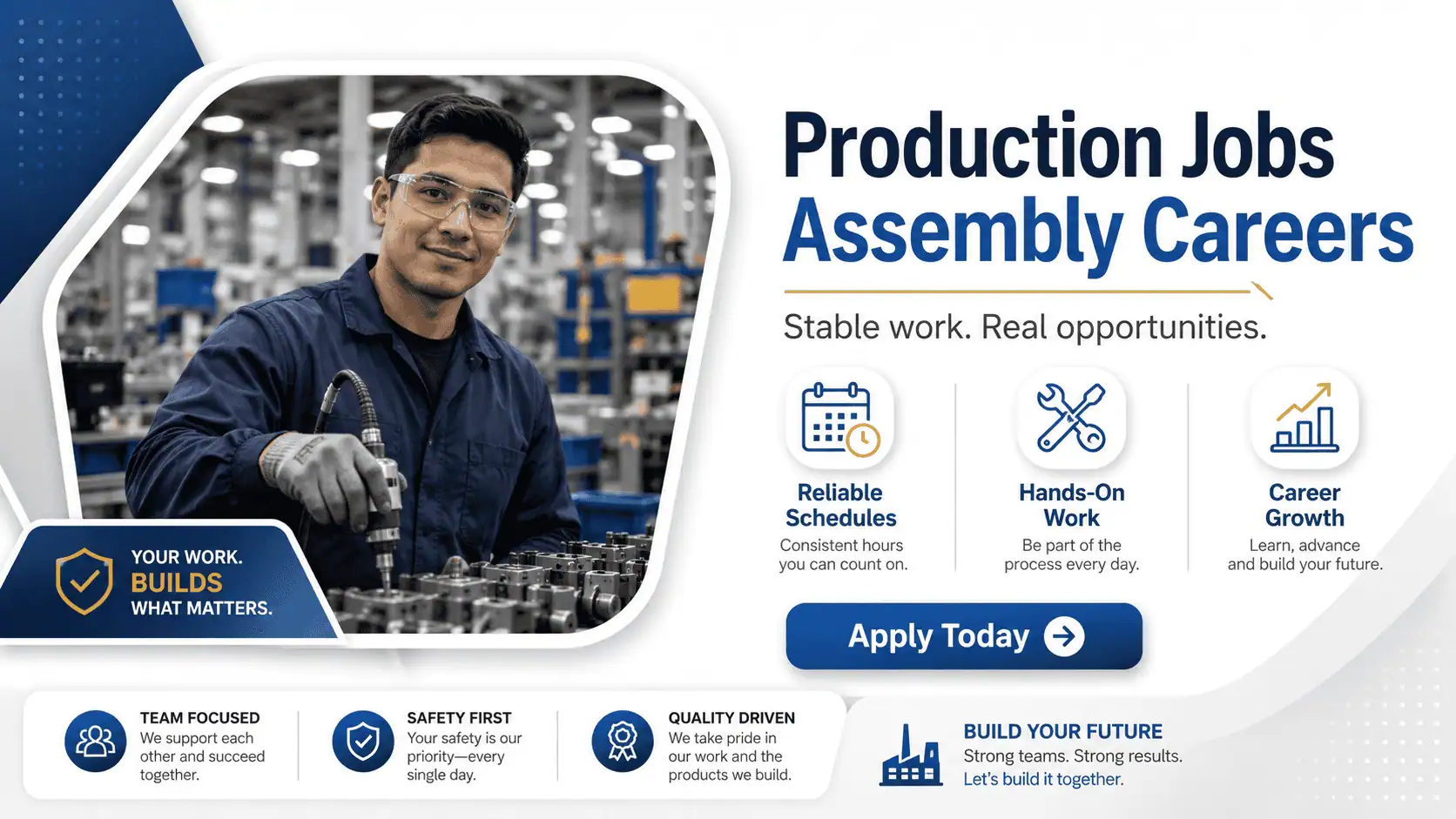
Manufacturing jobs support the production of vehicles, electronics, medical devices, food, furniture, machinery and thousands of other products used across the United States. These careers can provide an entry point for applicants who enjoy practical responsibilities, organized processes and working as part of a production team.
A manufacturing facility may employ assemblers, machine operators, production associates, packers, quality inspectors, material handlers and maintenance workers. Some positions accept candidates with limited experience and provide training after hiring, while technical roles may require certificates, apprenticeships or previous equipment experience.
The U.S. Bureau of Labor Statistics reports that miscellaneous assemblers and fabricators represented the largest production occupation in 2024, with approximately 1.5 million jobs. It also projects that industrial machinery mechanics will add more jobs than any other occupation within manufacturing between 2024 and 2034.
Manufacturing job overview
| Employment detail | General information |
|---|---|
| Industry | Production and manufacturing |
| Common level | Entry-level, skilled and technical |
| Work locations | Factories, plants and assembly facilities |
| Common schedules | Day, evening, overnight and rotating shifts |
| Main activities | Assembly, operation, inspection and packaging |
| Training | Often provided on the job for entry-level positions |
| Application method | Official employer or trusted employment platform |
A manufacturing job should be evaluated using the complete posting. Positions with similar titles can involve different equipment, products, physical requirements and schedules.
Manufacturing jobs you may find
Manufacturing is not a single occupation. A plant can require several teams to transform raw materials or components into finished products.
Production Associate
Production associates support one or more stages of the manufacturing process.
They may:
- Prepare materials
- Supply production stations
- Assemble basic components
- Package finished goods
- Label products
- Record production totals
- Inspect visible product conditions
- Clean assigned work areas
- Follow safety procedures
- Report production problems
This title can have broad responsibilities, so applicants should read the job description carefully.
Assembler
Assemblers build products or connect components according to instructions, diagrams or production standards.
Assemblers and fabricators generally construct finished products and the parts used to make them. Most work in manufacturing plants, where tools or automated systems may assist with difficult tasks.
A typical assembler may:
- Review work instructions.
- Collect required parts.
- Position components.
- Use hand or power tools.
- Fasten, connect or install parts.
- Check alignment.
- Test basic functions.
- Record completed work.
- Identify defects.
- Move the product to the next station.
Accuracy matters because one incorrectly installed component can affect the entire finished product.
Machine Operator
Machine operators prepare, monitor or control equipment used during production.
Their responsibilities may include:
- Loading raw materials
- Selecting approved machine settings
- Starting and stopping equipment
- Monitoring production
- Measuring finished parts
- Removing completed products
- Reporting unusual sounds or movements
- Performing authorized basic cleaning
- Recording production information
Operators should never attempt repairs or adjustments outside their training.
Packaging Associate
Packaging employees prepare finished products for storage, shipment or retail distribution.
Possible duties include:
- Inspecting product condition
- Placing products into containers
- Adding protective materials
- Applying labels
- Sealing packages
- Checking quantities
- Building cartons
- Preparing pallets
- Recording package information
- Reporting damaged items
Packaging work can be repetitive, but accuracy remains important. The wrong quantity or label can delay shipments and create inventory problems.
Quality Inspector
Quality employees review materials or finished products to determine whether they meet established standards.
They may:
- Compare products with specifications
- Measure parts
- Look for visible defects
- Test basic functions
- Record inspection results
- Separate rejected products
- Report recurring problems
- Communicate with production employees
Some quality positions require experience using measuring tools or understanding technical drawings.
What is assembly-line work like?
An assembly line divides production into several stages. Each employee or station completes a defined task before the product moves forward.
For example:
| Production stage | Possible task |
|---|---|
| Material preparation | Organize required components |
| Initial assembly | Connect major parts |
| Secondary assembly | Add smaller components |
| Inspection | Check alignment and condition |
| Testing | Confirm basic operation |
| Packaging | Prepare the product for shipment |
This system can improve efficiency, but employees must maintain both pace and accuracy.
Working too slowly may interrupt production. Working too quickly without following instructions can create defects or safety problems. Successful employees learn to complete their duties consistently rather than focusing only on speed.
Entry requirements and training
For many assembler and fabricator jobs, a high school diploma or equivalent may be sufficient. Employees generally receive on-the-job training, although advanced assembly work may require additional education, experience or technical instruction.
A vacancy may request:
- A high school diploma or equivalent
- Basic reading and numerical ability
- Previous production experience
- Comfort using tools
- Ability to follow written instructions
- Ability to work the assigned shift
- Attention to detail
- Safe work habits
- Reliable transportation
- Legal authorization to work
Technical positions may also request:
- Welding certification
- Electrical knowledge
- Blueprint-reading experience
- Forklift authorization
- Computer-controlled machine experience
- Mechanical training
- Quality-control experience
Do not claim a technical qualification you do not possess. Employers may verify training or require practical testing.
Physical demands in manufacturing
Manufacturing facilities can differ significantly. Some are climate-controlled and highly automated, while others may be noisy, warm or physically demanding.
A production worker may need to:
- Stand for extended periods
- Repeat hand or arm movements
- Bend or reach
- Lift materials
- Push carts
- Wear protective equipment
- Work near machinery
- Maintain concentration
- Complete detailed tasks
- Work in changing temperatures
The Bureau of Labor Statistics identifies production occupations as a broad group that includes assemblers, machine operators, food-processing employees, machinists, welders and other manufacturing workers.
Applicants should review the physical requirements of the individual opening rather than assuming that all factory jobs are alike.
Manufacturing safety basics
Safety procedures are essential around equipment, materials and moving production lines.
A responsible employee should:
- Wear required protective equipment
- Keep emergency areas clear
- Follow lockout and equipment procedures
- Use tools only after training
- Report damaged equipment
- Avoid loose clothing near machinery
- Clean spills according to procedure
- Use safe lifting methods
- Follow signs and floor markings
- Never bypass a machine guard
Production goals should never be used as a reason to ignore safety rules.
Shift types you may encounter
Manufacturing plants may operate continuously, creating several possible schedules.
First shift
Usually begins in the morning and ends during the afternoon.
Second shift
Often begins during the afternoon and ends late at night.
Third shift
Generally operates overnight.
Rotating shift
Employees alternate between schedules according to a set pattern.
Compressed schedule
Workers may complete longer shifts on fewer days each week.
Weekend shift
Some facilities use dedicated weekend teams.
Before applying, confirm:
- Start and end times
- Shift rotation
- Required overtime
- Weekend expectations
- Break schedules
- Weekly hours
- Temporary or permanent status
- Transportation availability
An overnight job may offer different compensation, but the schedule must be realistic for the applicant.
Skills employers may value
Manufacturing employers often look for candidates who can follow procedures consistently.
Operational skills
- Assembly
- Packaging
- Machine monitoring
- Inventory handling
- Quality inspection
- Tool use
- Labeling
- Material preparation
Workplace skills
- Dependability
- Punctuality
- Teamwork
- Attention to detail
- Time management
- Communication
- Adaptability
- Safety awareness
Technical skills
- Blueprint reading
- Measuring tools
- Mechanical knowledge
- Computer-controlled equipment
- Welding
- Electrical assembly
- Preventive maintenance
Technical skills are not necessary for every entry-level position, but they can expand future career options.
Improve your résumé descriptions
Weak description:
Worked on a production line.
Stronger description:
Assembled product components, inspected finished units and maintained an organized workstation while following production and safety procedures.
Additional résumé phrases include:
- Packaged finished products according to instructions
- Operated authorized production equipment
- Inspected materials for visible defects
- Recorded production quantities accurately
- Replenished assembly stations
- Followed written work orders
- Reported equipment irregularities
- Maintained clean and safe production areas
- Coordinated tasks with team members
- Completed repetitive duties consistently
Use only statements that reflect your real experience.
How to compare manufacturing opportunities
Do not choose a job using the hourly rate alone.
| Factor | What to verify |
|---|---|
| Base pay | Hourly rate shown in the posting |
| Shift differential | Additional pay for nights or weekends |
| Weekly hours | Guaranteed or variable |
| Overtime | Required, optional or unavailable |
| Employment status | Temporary, contract or permanent |
| Physical duties | Lifting, standing and repeated movements |
| Environment | Temperature, noise and protective equipment |
| Benefits | Eligibility and waiting periods |
| Transportation | Realistic access to the facility |
| Training | Paid training and advancement opportunities |
A position with a higher rate may be less practical when it requires an unreliable commute or mandatory rotating shifts.
Potential career progression
An entry-level production job can help employees develop skills for other manufacturing roles.
A possible path might include:
- Production Associate
- Experienced Assembler
- Machine Operator
- Quality Technician
- Team Lead
- Maintenance Technician
- Production Supervisor
Advancement is not automatic. It may depend on attendance, performance, technical training and available openings.
Workers interested in growth can focus on:
- Learning multiple production areas
- Completing safety training
- Developing measurement skills
- Studying mechanical systems
- Improving computer skills
- Maintaining reliable attendance
- Requesting authorized cross-training
How to apply for manufacturing jobs
Step 1: Select a job category
Choose between assembly, machine operation, packaging, inspection or material handling.
Step 2: Search by specific title
Useful search terms include:
- Production Associate
- Manufacturing Associate
- Assembly Worker
- Machine Operator
- Packaging Associate
- Quality Inspector
- Material Handler
- Production Technician
Step 3: Enter your location
Search within a realistic commuting distance.
Step 4: read the entire vacancy
Confirm:
- Product or industry
- Facility location
- Shift
- Hourly pay
- Employment status
- Physical requirements
- Experience requirements
- Required equipment
- Benefits
Step 5: Prepare your information
Have your employment history, education, certifications and availability ready.
Step 6: Submit an accurate application
Use specific examples of production, warehouse, retail or practical experience.
Step 7: Prepare for screening
Some employers may use:
- Interviews
- Skills assessments
- Measuring exercises
- Equipment evaluations
- Background checks
- Pre-employment requirements permitted by law
Follow instructions from the authorized employer.
Avoid manufacturing job scams
Be cautious when a supposed recruiter:
- Requests an application fee
- Guarantees employment
- Refuses to identify the plant
- Offers unusually high pay without qualifications
- Communicates only through an unofficial account
- Sends a check and requests money back
- Asks for banking information before legitimate hiring steps
- Uses a copied company website
Verify the vacancy through the employer’s official website or a trusted public employment service.
Manufacturing can offer practical experience in production, technology, quality and logistics. Compare current vacancies carefully and choose work that matches your abilities, schedule, transportation and long-term career goals.