Help Keep America Moving: Discover Trucking and Transportation Careers
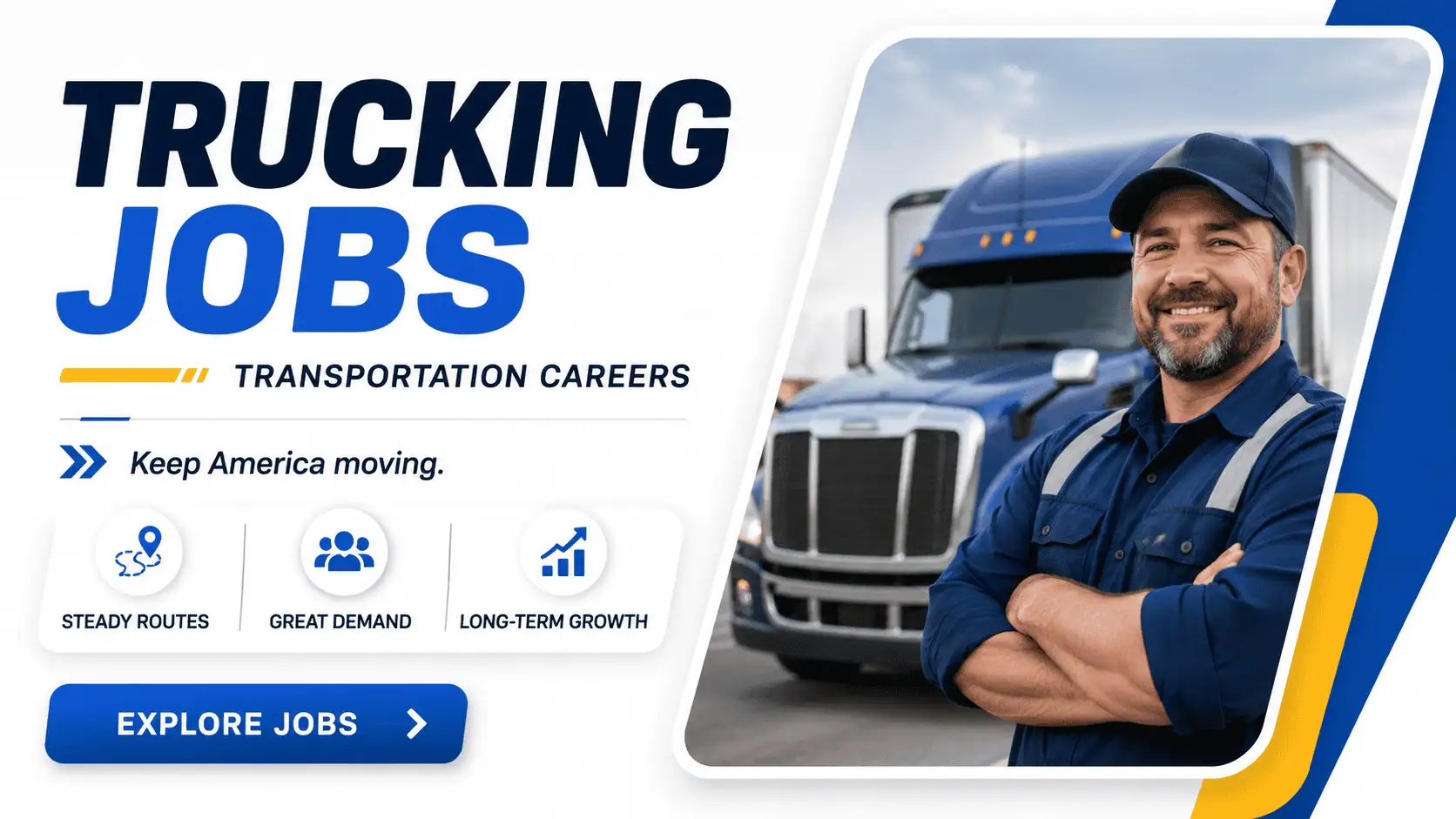
Commercial truck drivers transport food, construction materials, retail products, machinery and other goods between warehouses, businesses and distribution centers. Their work supports supply chains throughout the United States.
A trucking career can offer opportunities for local, regional or long-distance work. However, operating a large commercial vehicle requires specialized training, responsible driving and compliance with transportation regulations.
The U.S. Bureau of Labor Statistics projects employment for heavy and tractor-trailer truck drivers to grow 4% from 2024 through 2034. It estimates approximately 237,600 openings per year, on average, over that period.
Trucking career overview
| Employment detail | General information |
|---|---|
| Industry | Transportation and logistics |
| Common vehicle | Heavy or tractor-trailer truck |
| Typical credential | Commercial Driver’s License |
| Training | Professional driving program and employer training |
| Work areas | Local, regional and long-distance routes |
| Main responsibility | Transport goods safely and on schedule |
| Job availability | Depends on freight demand and location |
Driving a commercial truck is not the same as driving a personal vehicle. Drivers must account for vehicle size, stopping distance, cargo weight, road restrictions and federal or state requirements.
Types of truck-driving careers
Local Truck Driver
Local drivers generally begin and end their routes within the same geographic region.
They may deliver:
- Food and beverages
- Retail merchandise
- Construction materials
- Commercial supplies
- Furniture
- Industrial products
- Automotive parts
Advantages may include returning home more frequently. However, local drivers can face heavy traffic, repeated stops and significant loading or unloading responsibilities.
Regional Driver
Regional drivers operate within a defined group of states or areas.
A regional schedule may include:
- Several days on the road
- Regular routes
- Distribution-center stops
- Overnight travel
- Weekend work
- Scheduled home time
The exact schedule depends on the carrier and freight network.
Over-the-Road Driver
Over-the-road drivers, often called OTR drivers, can travel long distances across several states.
The work may involve:
- Extended periods away from home
- Sleeping in the truck
- Changing weather conditions
- Long-distance route planning
- Interstate regulations
- Delivery appointments
- Rest periods away from home
Candidates should evaluate the lifestyle as carefully as the compensation.
Dedicated Route Driver
Dedicated drivers serve a particular customer, facility or route network.
This arrangement may provide:
- More predictable destinations
- Familiar warehouses
- Regular customers
- Repeated schedules
- Potentially consistent home time
The route can still change according to freight needs.
Team Driver
Two qualified drivers share one truck and alternate driving responsibilities to keep freight moving for more hours.
Team driving requires:
- Strong communication
- Respect for shared space
- Coordinated rest periods
- Similar safety standards
- Clear responsibility for inspections and records
Applicants should understand the team arrangement before accepting the position.
What truck drivers do beyond driving
Heavy and tractor-trailer drivers transport goods between locations, but their responsibilities generally extend beyond operating the vehicle.
A typical assignment may include:
- Reviewing dispatch information.
- Inspecting the vehicle.
- Confirming cargo documentation.
- Checking that freight is secured.
- Planning or reviewing the route.
- Driving according to safety rules.
- Communicating with dispatch.
- Recording required duty information.
- Delivering to the correct facility.
- Reporting delays, damage or equipment concerns.
Drivers may also help load or unload cargo, depending on the employer and shipment.
Commercial Driver’s License basics
Most people who operate qualifying commercial motor vehicles must obtain a Commercial Driver’s License, commonly called a CDL, through their home state. Federal guidance states that it is illegal to hold commercial licenses from more than one state.
The process generally includes:
- Meeting state eligibility requirements
- Obtaining a Commercial Learner’s Permit
- Completing required training
- Passing knowledge tests
- Passing a skills test
- Meeting medical requirements
- Receiving the appropriate CDL class
- Adding endorsements when required
Federal Entry-Level Driver Training rules establish minimum training requirements that certain new drivers must complete before taking specified CDL skills or endorsement tests.
Requirements can vary by state and vehicle type. Applicants should use their state licensing agency and the Federal Motor Carrier Safety Administration for official guidance.
CDL classes
Class A
Generally used for qualifying combination vehicles, such as tractor-trailers.
Class B
Generally applies to qualifying single vehicles, including certain large straight trucks.
Class C
Can apply to certain vehicles designed to transport passengers or regulated materials when they do not meet Class A or B definitions.
The correct class depends on the vehicle and operation. Do not enroll in training without understanding which license matches your intended career.
Common CDL endorsements
Some driving jobs require additional endorsements.
These may include authorization for:
- Tank vehicles
- Passenger vehicles
- School buses
- Double or triple trailers
- Regulated hazardous materials
Each endorsement can require additional testing or screening. A driver should never operate equipment or transport cargo without the required license and endorsement.
Driver medical requirements
Commercial driving can require a medical examination to confirm that the driver meets applicable physical-qualification standards.
The Bureau of Labor Statistics notes that federal regulations include hearing-related standards for heavy and tractor-trailer truck drivers. Medical requirements cover several areas and should be reviewed with an authorized medical examiner and official regulatory sources.
Applicants should not assume that holding a regular driver’s license automatically satisfies commercial-driving requirements.
Pre-trip inspection responsibilities
A professional driver should inspect the vehicle before operating it.
An inspection can include:
| Vehicle area | Items that may be checked |
|---|---|
| Tires and wheels | Condition, inflation and visible damage |
| Lights | Headlights, brake lights and signals |
| Brakes | Warning signs and system condition |
| Mirrors | Position and visibility |
| Fluids | Leaks or unusual levels |
| Cargo | Security and distribution |
| Coupling | Connections between tractor and trailer |
| Emergency equipment | Required safety supplies |
Drivers must follow the employer’s procedures and applicable inspection rules.
Safety comes before delivery speed
A delivery appointment does not justify unsafe driving.
Professional drivers should:
- Obey speed limits
- Maintain safe following distance
- Adjust for weather
- Wear a seat belt
- Avoid distracted driving
- Complete required rest periods
- Report unsafe equipment
- Secure cargo correctly
- Use extra caution when backing
- Follow route restrictions
Pressure from a dispatcher or customer should never be used as a reason to violate safety regulations.
Local, regional or OTR: compare the options
| Career factor | Local | Regional | OTR |
|---|---|---|---|
| Typical distance | Shorter | Multiple cities or states | Long-distance |
| Home time | Often frequent | Scheduled intervals | May be less frequent |
| Loading activity | Can be frequent | Depends on freight | Depends on carrier |
| Route familiarity | Often high | Moderate | More variable |
| Lifestyle impact | Lower travel impact | Moderate | Significant |
| Traffic exposure | Often urban | Mixed | Highway-focused |
| Schedule | May be daily | Multi-day | Extended trips |
No single option is best for everyone. Applicants should consider family commitments, health, preferred driving environment and time away from home.
Employee driver or owner-operator?
Company driver
A company driver generally operates an employer-provided truck.
The employer may be responsible for:
- Truck ownership
- Major maintenance
- Commercial insurance
- Operating permits
- Dispatch
- Customer contracts
The driver receives compensation under the company’s employment arrangement.
Owner-operator
An owner-operator runs an independent trucking business or contracts with a carrier.
They may be responsible for:
- Truck purchase or lease
- Fuel
- Maintenance
- Insurance
- Permits
- Taxes
- Recordkeeping
- Business expenses
- Finding or accepting freight
A large gross payment does not equal take-home income. Business expenses can be substantial.
New drivers should understand the financial and legal responsibilities before considering an owner-operator arrangement.
How truck drivers may be paid
Compensation structures can include:
- Hourly pay
- Pay per mile
- Salary
- Route pay
- Percentage of load revenue
- Stop pay
- Detention pay
- Safety bonuses
- Sign-on incentives
Applicants should ask:
- Are all miles paid?
- How are empty miles handled?
- Is waiting time compensated?
- Is loading or unloading paid?
- How often is compensation issued?
- Are bonuses guaranteed or conditional?
- What expenses are deducted?
- Is training paid?
- Is there guaranteed weekly compensation?
- How is home time scheduled?
The highest advertised number may depend on bonuses, perfect attendance or unusually high mileage.
Skills needed in trucking
Driving skills
- Vehicle control
- Safe turning
- Backing
- Space management
- Defensive driving
- Route awareness
Operational skills
- Vehicle inspection
- Cargo securement
- Documentation
- Electronic logging
- Navigation
- Time planning
Personal qualities
- Responsibility
- Patience
- Independence
- Concentration
- Communication
- Adaptability
- Good judgment
Customer-service skills
Truck drivers regularly interact with dispatchers, warehouse employees, customers and inspectors. Professional communication remains important even when delays occur.
Improve your trucking résumé
Weak description:
Drove a truck and delivered products.
Stronger description:
Completed scheduled commercial deliveries, performed vehicle inspections and maintained accurate route documentation while following company and traffic-safety procedures.
Other useful phrases include:
- Inspected vehicle before and after assigned routes
- Secured cargo according to procedure
- Communicated delivery delays to dispatch
- Maintained accurate electronic records
- Completed deliveries within scheduled windows
- Followed route and vehicle restrictions
- Assisted with safe loading and unloading
- Reported mechanical concerns promptly
Only include commercial-driving experience and credentials you actually possess.
How to start a trucking career
Step 1: Review the lifestyle
Decide whether local, regional or long-distance work fits your circumstances.
Step 2: Check state requirements
Consult your state driver-licensing agency.
Step 3: Identify the required CDL class
Match the license to the vehicle and job you want.
Step 4: Research approved training
Confirm that the provider meets applicable Entry-Level Driver Training requirements.
Step 5: Compare training costs
Review:
- Tuition
- Equipment fees
- Testing fees
- Financing
- Employer sponsorship
- Repayment agreements
- Contract conditions
Step 6: Complete licensing requirements
Follow official state and federal instructions.
Step 7: Search verified openings
Use employer websites or trusted public employment resources.
Step 8: Compare the full offer
Review compensation, home time, route, equipment, benefits and employment conditions.
Employer-sponsored CDL training
Some carriers offer CDL training or tuition assistance. These programs can reduce upfront costs, but they may require the driver to work for the carrier for a particular period.
Read the agreement carefully.
Questions to ask include:
- Is training paid?
- Who pays licensing fees?
- Is there an employment commitment?
- What happens if the driver leaves early?
- Is repayment required?
- What compensation applies during training?
- Is employment guaranteed after completion?
- Which routes are available afterward?
Do not sign an agreement you do not understand.
Watch for trucking job scams
Be cautious when an offer:
- Guarantees an unusually high income
- Requires immediate payment
- Hides the carrier’s legal name
- Promises a CDL without testing
- Offers to bypass medical or licensing requirements
- Requests banking information through an unofficial account
- Sends a check and asks you to return money
- Avoids discussing deductions
- Pressures you to sign a lease immediately
Commercial licensing and safety requirements cannot legitimately be skipped.
Trucking can provide a long-term career in transportation, but applicants should approach it carefully. Learn the licensing process, compare driving categories and choose an employer whose compensation, safety practices and schedule match your goals.